

On This Page

(Scroll Down)


1. Intro to Oviedo golf.

2. Commitment.

3. Sport Psychology - February: 'Confidence v Efficacy'

4. Training with Intention

5. End of February Workout

6. Whay play in Tournaments (or Rounds that Count)?


_______________

Oviedo High School Golf


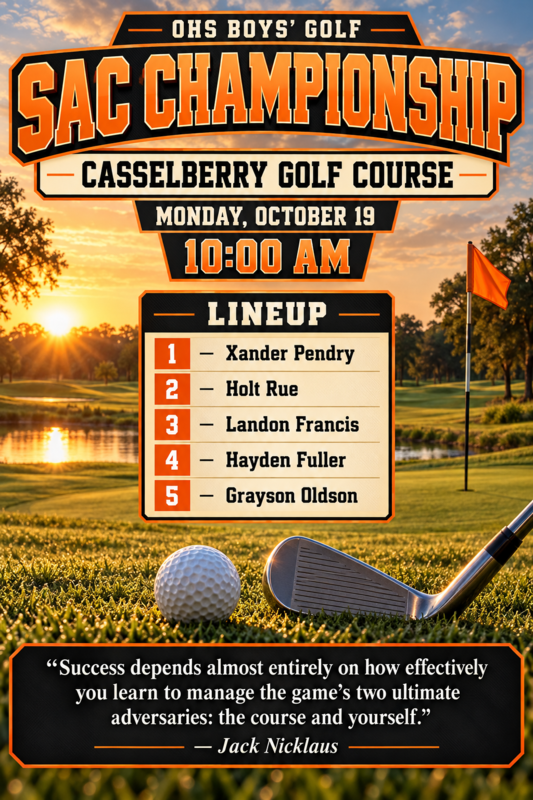
The Oviedo High School Boys Golf Team has grown into one of the top programs in our area. After back-to-back runner-up finishes in the SAC and District 4, we ended the 2025 season ranked #16 in the state—missing the State Championship by just tenths of a point.


We are already training for next season and looking for dedicated golfers to continue that tradition.


If you are new to Oviedo or didn’t play this year, now is the time to get started. Each month, we post structured range workouts and training guidance on this website. If you commit to the work, you give yourself a real opportunity to earn a spot on the team next fall.


_______________

Commitment 


Anyone who wants to play golf at Oviedo High School next year has a real opportunity right now to get significantly better before tryouts. You still have five months to get ready. 


That improvement comes from consistent work — following the monthly online workouts, training both the physical and mental sides of the game, and preparing well before August arrives.


If you do the work, you will improve and give yourself a good chance to make the team.

We compete against top teams and expect full commitment. Simply wanting to be on the team is not enough. Spots must be earned.


PROGRAM EXPECTATIONS (NOW → AUGUST)

Players serious about making the team should aim for:

  • 3–4 hours of practice per week

  • Use our monthly range workouts

  • Learning and applying sports psychology material

  • Play two (2) 9-hole rounds per month

  • Play one 18-hole round every 6 weeks

Including rounds, this averages about 5 hours per week and leads to real improvement.


If that level of commitment feels like too much, this program may not be the right fit — and that’s okay. Our program is for players who want more: to improve, to compete, and to be part of something bigger than themselves.


If you’re ready to put in the work, we will support you every step of the way.


Whether you are new to Oviedo High School next year or already here but didn’t play last season, if this sounds like a fit for you, contact Coach Howell at:

john_howell@scps.k12.fl.us


_______________

Sports Psychology - Dr. Gio Valiante

Topic Three: Confidence and Efficacy


We’ve all heard it: “Play with confidence and you’ll play better.” That’s true—but confidence often depends on past success. So what happens when you’re still building your game?


That’s where self-efficacy comes in.


Psychologist Albert Bandura defined self-efficacy as your belief in your ability to succeed at a specific task—even if you haven’t done it yet. It answers one simple question:


“Do I believe I can do this?”


When you stand on the tee, face a tough chip, or line up a pressure putt, your belief shapes your performance. The good news? Self-efficacy can be built—through preparation, mindset, and persistence.


The Four Sources of Self-Efficacy

  1. Mastery Experiences – Success builds belief.
    Solid shots, improved rounds, and learning from failure all strengthen confidence. What you repeat becomes what you expect.

  2. Vicarious Experiences – Seeing others succeed matters.
    Watching teammates perform under pressure helps you believe you can too.

  3. Verbal Persuasion – Words matter.
    Specific encouragement from coaches and teammates reinforces belief.

  4. Emotional Control – Calm body, clear mind.
    Managing nerves and staying composed strengthens trust in your swing.


Why It Matters in Golf


Golf is mentally demanding. You have time to think—and often replay mistakes. Players with high self-efficacy:

  • Stay motivated after tough rounds

  • Stick to routines under pressure

  • Bounce back quickly from bad holes

  • Practice with purpose

  • Swing decisively instead of fearfully

The difference isn’t always talent—it’s belief.


How to Build It

  • Set achievable goals and track progress

  • Reflect on small wins

  • Visualize successful shots

  • Practice intentionally

  • Learn from mistakes without letting them define you

Self-confidence comes and goes.
Self-efficacy is built.

And when belief is built, performance follows.

_______________

Training with Intention


Monthly Focus: Wedges & Consistency

This Month’s Theme: Control the Golf Ball


Good golf is not about perfect shots — it’s about predictable shots.


The fastest way to lower scores is to improve from inside 150 yards, where wedges, ball control, and decision-making matter most.


This month emphasizes:

  • Wedge distance control

  • Predictable ball flight

  • Balance and tempo

  • Consistency over power

If you can control a wedge, every other club becomes easier.


Why This Matters

Most high school golfers lose strokes because they:

  • Don’t know their true wedge distances

  • Swing wedges too hard or too soft

  • Miss greens from scoring range

  • Lose balance with the driver

  • Chase perfect shots instead of repeatable ones

This month addresses those issues directly.

You will learn:

  • Your real wedge carry distances

  • Your natural shot shape

  • How to adjust trajectory when needed

  • How to swing the driver under control

The goal is not highlight shots.
The goal is reliable golf.


What We’re Training

  • Wedges → distance control and tighter dispersion

  • Ball flight → fades, draws, and straight shots

  • Driver balance → controlled speed

  • Putting under pressure → fewer wasted strokes

Everything you train this month shows up on the scorecard.


_______________

Workout

Theme: Precision over power
Total Time: 65 minutes
Objective: Build real wedge distances + tighter dispersion + predictable ball flight


1️⃣ Wedge Distance Calibration (20 minutes)

Clubs: PW, GW, SW (or 3 scoring wedges)

Structure:

  • 5 balls to 60 yards

  • 5 balls to 80 yards

  • 5 balls to 100 yards

  • 5 balls to 120 yards

Players must:

  • Pick exact landing spot (not “around there”)

  • Call carry number before swinging

  • Hold finish for 3 seconds

Scoring:

  • Inside 15 feet = 2 points

  • Outside 15 ft = 1 point

  • Miss = 0

Goal: 20+ points

This forces:

  • Real carry awareness

  • Controlled tempo

  • Balanced finishes


2️⃣ Trajectory & Shot Shape Control (15 minutes)

Ball Flight Ladder

For each wedge:

  • 1 low shot

  • 1 stock shot

  • 1 higher flighted shot

Then:

  • 1 soft fade

  • 1 soft draw

Must hold finish and identify curvature immediately.

Purpose:

  • Build awareness of natural shape

  • Learn how trajectory changes carry

  • Improve face control


3️⃣ Driver Balance Window (15 minutes)

Not speed training. Control training.

Pick a 30-yard fairway window.

Hit 10 drivers at:

  • 80% speed

  • Balanced finish

  • No falling backward

Scoring:

  • Fairway window = 1 point

  • Off-line but controlled = 0

  • Out of control swing = -1

Goal: 6+ controlled drives.


“Driver is a positioning club, not a power contest.”


4️⃣ “Finish the Round” Putting Game (15 minutes)

3 stations:

  • 4 feet

  • 8 feet

  • 20 feet lag

Players must:

  • Make 4-footer

  • Two-putt from 20

  • Make or tap-in 8-footer

Miss any → restart cycle.

Simulates:

  • End-of-round focus

  • Emotional control

  • Routine under fatigue

_________________________________

Why Play in Tournaments or Rounds Where Every Shot Counts?


1️⃣ Pressure Reveals the Truth


On the range:

  • Lie is perfect

  • No consequence

  • No scorecard

In competition:

  • Heart rate rises

  • Palms get sweaty

  • Muscles tense

  • Decisions matter

  • Every swing has a consequence

Pressure exposes:

  • Short-game weaknesses

  • Driver control inconsistencies

  • Emotional lapses under pressure

  • Poor decision-making


2️⃣ Transfer Training


Many players are “range good” but not “travel good.”


Competition forces:

  • Club changes

  • Uneven lies

  • Wind adjustments

  • Strategic thinking

That transfer is what separates:

  • 80 shooters from 75 shooters

  • Good ball strikers from good scorers


3️⃣ Emotional Discipline Development


Golf is a recovery sport.


Tournaments train:

  • Bounce-back ability

  • Routine under stress

  • Post-mistake composure

  • Tempo control when adrenaline spikes


4️⃣ Scorecard Awareness


Off-season rounds show you exactly where strokes are lost:

  • Inside 150 dispersion

  • 6-foot putt percentage

  • Penalty frequency

  • Up-and-down efficiency


5️⃣ Confidence That’s Earned


Range confidence is fragile.

Tournament confidence is durable.


When a player proves to themselves:
“I can post a number when it counts,”
belief strengthens permanently.


6️⃣ Recruiting & Competitive Readiness


For high school players especially:

  • You learn pace of play

  • You learn tournament etiquette

  • You build competitive reps

  • You reduce first-event nerves in season

The first tournament of the season shouldn’t feel new.

_________________________________


The OHS Boys Golf Team is extremely proud of Xander Pendry for battling through three demanding days of competition to capture the Tuscawilla Country Club Championship on Sunday, February 8.


After falling into a tie with just four holes remaining, Xander showed tremendous composure and competitive maturity—playing those final holes at 1-under par to secure the victory.


Champions respond when the pressure is highest, and his performance reflects the discipline, preparation, and mental toughness we value in our program.


Congratulations, Xander. Your team is proud of you.


Hit Counter
Number of Visitors:
43305